Deployments#
First create a deployment for the trained model that generates a probability distribution for a given image URL. You can specify the compute you want to use with ray_actor_options, and how you want to horizontally scale, with num_replicas, this specific deployment.
@serve.deployment(
    num_replicas="1",
    ray_actor_options={
        "num_gpus": 1,
        "accelerator_type": "T4",
    },
)
class ClassPredictor:
    def __init__(self, model_id, artifacts_dir, device="cuda"):
        """Initialize the model."""
        # Embdding model
        self.processor = CLIPProcessor.from_pretrained(model_id)
        self.model = CLIPModel.from_pretrained(model_id)
        self.model.to(device=device)
        self.device = device

        # Trained classifier
        self.predictor = TorchPredictor.from_artifacts_dir(artifacts_dir=artifacts_dir)
        self.preprocessor = self.predictor.preprocessor

    def get_probabilities(self, url):
        image = Image.fromarray(np.uint8(url_to_array(url=url))).convert("RGB")
        inputs = self.processor(images=[image], return_tensors="pt", padding=True).to(self.device)
        with torch.inference_mode():
            embedding = self.model.get_image_features(**inputs).cpu().numpy()
        outputs = self.predictor.predict_probabilities(
            collate_fn({"embedding": embedding}))
        return {"probabilities": outputs["probabilities"][0]}
🧱 Model composition
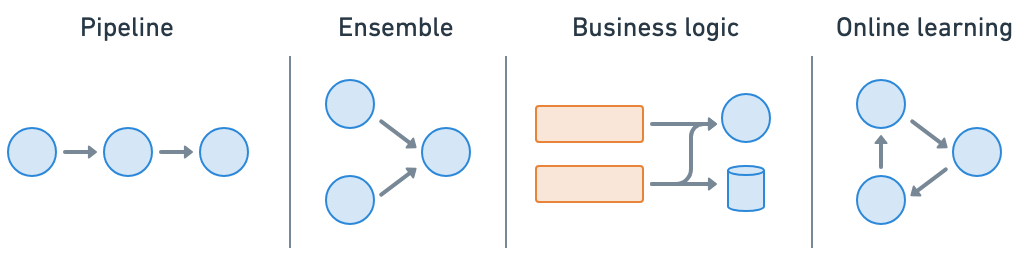
Ray Serve makes it easy to do model composition where you can compose multiple deployments containing ML models or business logic into a single application. You can independently scale even fractional resources, and configure each of your deployments.